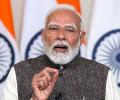
India on Saturday announced plans to amend its nuclear liability law and set up a nuclear energy mission, a move that came ahead of Prime Minister Narendra Modi's likely visit to the United States.

A nuclear liability regime would ensure compensation to the public in the event of an accident.
The government has finalised the much-awaited rules of implementation of the nuclear liability law, a move that could pave way for the expansion of the atomic power sector by procuring equipment from foreign suppliers. "A PMO committee has approved the rules of implementation of the civil nuclear liability law. We will notify the rules within a month," V Narayanasamy said. The Civil Liability for Nuclear Damage law was passed by Parliament last year.
Voicing "serious concern" over India's nuclear liability law, the United States on Friday said New Delhi could seek International Atomic Energy Agency's help in evaluating its legislation's compliance with the Convention on Supplemental Compensation.
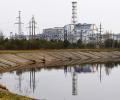
The Supreme Court is reviewing a plea challenging the 2025 SHANTI Act, which caps liability at Rs 3,000 crore for nuclear plant incidents, raising concerns about victim compensation and operator accountability.
What is in store for the Koodankulam nuclear power plants, asks S P Udayakumar.
India on Thursday firmly ruled out any change in the civil nuclear liability law notwithstanding repeated concerns expressed by countries exporting atomic equipments over compensation claim in the event of an accident.
Russia's global nuclear project company Atomstroyexport, which is building two 1000 MW reactors in Kudankulam, said the "complex issues" need to be addressed before firming up contracts for setting up two more atomic power plants.
Ahead of Prime Minister Manmohan Singh's visit to the United States, a controversy has broken out over the nuclear liability law with reports suggesting that an agreement will be signed which may not be in tune with the law.
Pitching for enactment of a law to fix civil damages caused by nuclear accidents, Atomic Energy Commission Chairman Srikumar Banerjee said neither the Indian Environmental Protection Public Liability Insurance Act, 1991, nor the Indian Atomic Energy Act had provisions for damages caused due to war or radioactivity.
Neither the United States government nor its powerful business lobby is likely to embrace the Indian law, which imposes unprecedented liability on the suppliers for 80 years, says TP Sreenivasan

The Indian government has introduced a bill to overhaul the civil nuclear sector, allowing private participation and establishing a new liability regime. The SHANTI Bill, 2025, aims to repeal existing acts and address industry concerns.

With the regulatory approval from the US Department of Energy in its kitty, Indian multinational conglomerate L&T is planning to focus on manufacturing small modular reactors (SMRs) to play a leading role in the commercialisation of nuclear energy in India.
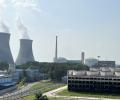
Government sources said amendments were being considered to the Atomic Energy Act to allow private sector participation and the Civil Liability for Nuclear Damage Act to limit the liability on suppliers of equipment to build atomic energy plants.

'If the BJP detoxifies the nuclear liability law, it will bring economic, environmental and, most of all, strategic benefits.' 'Let's keep our fingers crossed and hope that this Budget promise is met soon -- ideally, before Mr Modi heads to his first meeting with Trump 2.0,' observes Shekhar Gupta.
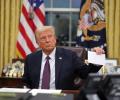
US President Donald Trump signed the National Defence Authorisation Act for Fiscal Year 2026 into law, highlighting broadened engagement with India and addressing the challenge posed by China in the Indo-Pacific region.
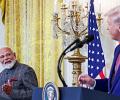
Prime Minister Narendra Modi and US President Donald Trump have vowed to move forward with plans to work together to build US-designed nuclear reactors in India. The decision was made during their meeting at the White House, where they also agreed to significantly expand energy cooperation. The move comes after India announced plans to amend its nuclear liability law and the Atomic Energy Act, which had previously been obstacles to the implementation of the US-India civil nuclear deal.
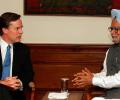
The India-US nuclear deal was aimed at ending India's nuclear isolation and nuclear apartheid, recalls Rup Narayan Das.

US urges New Delhi to align its nuclear liability law with the international convention
Paving the way for early enactment of nuclear liability law, a Parliamentary Committee on Wednesday presented its report that addresses major concerns of the Bharatiya Janata Party as it recommended provision for "clear-cut" accountability of suppliers for any mishap involving an atomic plant.
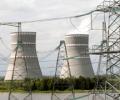
Under a 2010 nuclear liability law, nuclear equipment suppliers are liable for damages from an accident, which companies say is a sharp deviation from international norms
The Barack Obama administration is resigned to the reality that the Manmohan Singh government has little chance of salvaging the deal from the limbo it is in now and providing some leeway on the Nuclear Liability Law, experts tell Aziz Haniffa
Amidst growing concern in the United States Congress that the India-US nuclear deal is in limbo, the Barack Obama administration last week attempted, albeit weakly, to assuage the angst that Washington has been taken for a ride by New Delhi. Parliament's nuclear liability law has left American companies hanging after all of the capital they extended in pushing the accord through both the US Senate and the House of Representatives.

Civil nuclear projects in the country would be subject to Indian laws including on issues of civil liability, National Security Adviser Shivshankar Menon said on Friday dismissing reports of attempts to dilute the liability clause in contracts proposed with United States firms.
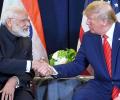
It would be the prime minister's first bilateral visit to the US after Trump became president for a second term.
Although the Nuclear Liability Law passed by Parliament has left the India-United States nuclear agreement in limbo, both countries at the end of their Strategic Dialogue in Washington pointed to the agreement between Westinghouse and the Nuclear Power Corporation of India as a tangible step toward ultimate implementation of the agreement.

What we are watching is something different: A fog manufactured and maintained by the people who started the war, so that the question of why it was started never has to be answered, observes Prem Panicker in his must read blog on the war in the Middle East.
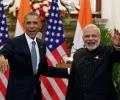
'At a time when the entire India-US relationship needs to be defined by President Trump and Prime Minister Modi, a fresh look at the liability issue has become urgent,' says Ambassador T P Sreenivasan, former Governor for India at the IAEA.

US Vice President JD Vance called on India to drop non-tariff barriers, give greater access to its markets and buy more American energy products and military hardware. Vance, in a speech in Jaipur, highlighted the need for a stronger US-India partnership for a prosperous and peaceful 21st century. He emphasized the importance of working together to address global challenges and praised Prime Minister Narendra Modi, describing him as a "special person." Vance also urged India to provide greater market access to American products and buy more defense platforms and energy from the US. He suggested that India consider dropping some of the non-tariff barriers for American access to the Indian market and highlighted the benefits of closer India-US defense collaboration, advocating for New Delhi to procure more military hardware from the US. He cited the example of American fifth-generation F-35s, arguing they would give the Indian Air Force the ability to defend its airspace and protect its people like never before. Vance also welcomed the Modi government's budget announcement to amend India's civil nuclear liability laws, paving the way for US producers to export small modular reactors and build larger US-designed reactors in India. He emphasized the importance of energy security for India's AI ambitions, stating "there is no AI future without energy security and energy dominance." Vance's visit comes amid growing global concerns over the US's tariff war.
'Why should we disclose classified information to satisfy those who doubt our Hydrogen Bomb capability?'
Larsen & Toubro Ltd (L&T) is deepening its push into data centres and defence manufacturing while keeping an eye on emerging opportunities in nuclear and thermal power, chairman and managing director SN Subrahmanyan said. The engineering and construction conglomerate has invested around Rs 2,200 crore in data centres, with 32 megawatts (Mw) already operational.

A top Obama administration official on Thursday said that though some progress is being made in the implementation of the Indo-US civilian nuclear deal, it is going to be a long and tough road to work through the issues related to India's nuclear liability law.

The agreement was reached in intensive negotiations between contact groups that Obama and Modi had set up in September.
Science and Technology Minister Prithviraj Chavan, who is in-charge of Department of Atomic Energy, said the country lacks a law under which compensation could be awarded in the case of a nuclear accident.
The pacts for units III and IV of the Koondakulam nuclear plant are "almost initialled" and would have been signed last December but for the protests, Russian Ambassador Alexander Kadakain said on Monday and maintained that the units don't fall under the recent nuclear liability law.
With the Indo-US civilian nuclear deal in a limbo in the wake of the Indian Parliament's nuclear liability law, the Barack Obama administration has asserted that complete implementation of the accord is imperative for the full transformation of the relationship.

India and the United States have reached the first commercial agreement on civilian nuclear power, five years after a landmark deal between the two countries was clinched.
The nuclear liability bill is fatally flawed. It's designed to shield the nuclear industry from discharging its public responsibility. It must be scrapped, writes Praful Bidwai
The ranking Republican on the powerful Senate Foreign Relations Committee, Senator Richard Lugar, has bemoaned the fact that more than three years after the historic US-India civilian nuclear deal was signed, it still remains in limbo sans any implementation.
United States has said it is looking at India to see what changes can be made in certain provisions in the Nuclear Liability Bill, which was recently passed by the Parliament.
